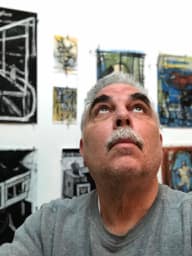
Taransky attended the Illinois Institute of Technology in Chicago studying Meis and the Bauhaus before moving to The Cooper Union in NYC to study with Dean John Hejduk and Raimund Abraham. His thesis “A Library for the Blind” was published in Education of an Architect ed. Diller and Hejduk (Rizzoli, 1988). Now called the “Thesis Bible”.
Richard’s work outside of practice earned him the “Rome Prize” in Architecture in 2001 and he is a Fellow of the American Academy in Rome.
In 2005 he was an artist in resident at The Fabric Workshop & Museum, in Philadelphia, where he completed work on “Civil Settlement,” a silk screened tablecloth / city plan which is housed in the FWM permanent collection. Last year he received an “Emily Harvey Fellowship” in Venice doing work on Aquatic Architecture.
Richard has taught courses in design, drawing, and technology at The Cooper Union, llinois Institute of Technology, Tyler School of Architecture, and The University of the Arts. He was named “The John G. Williams Distinguished Professor” at The University of Arkansas, where he was in the Fay Jones School of Architecture.
His work has been exhibited and published widely including collaborations with his daughter, The Poet Michelle Taransky